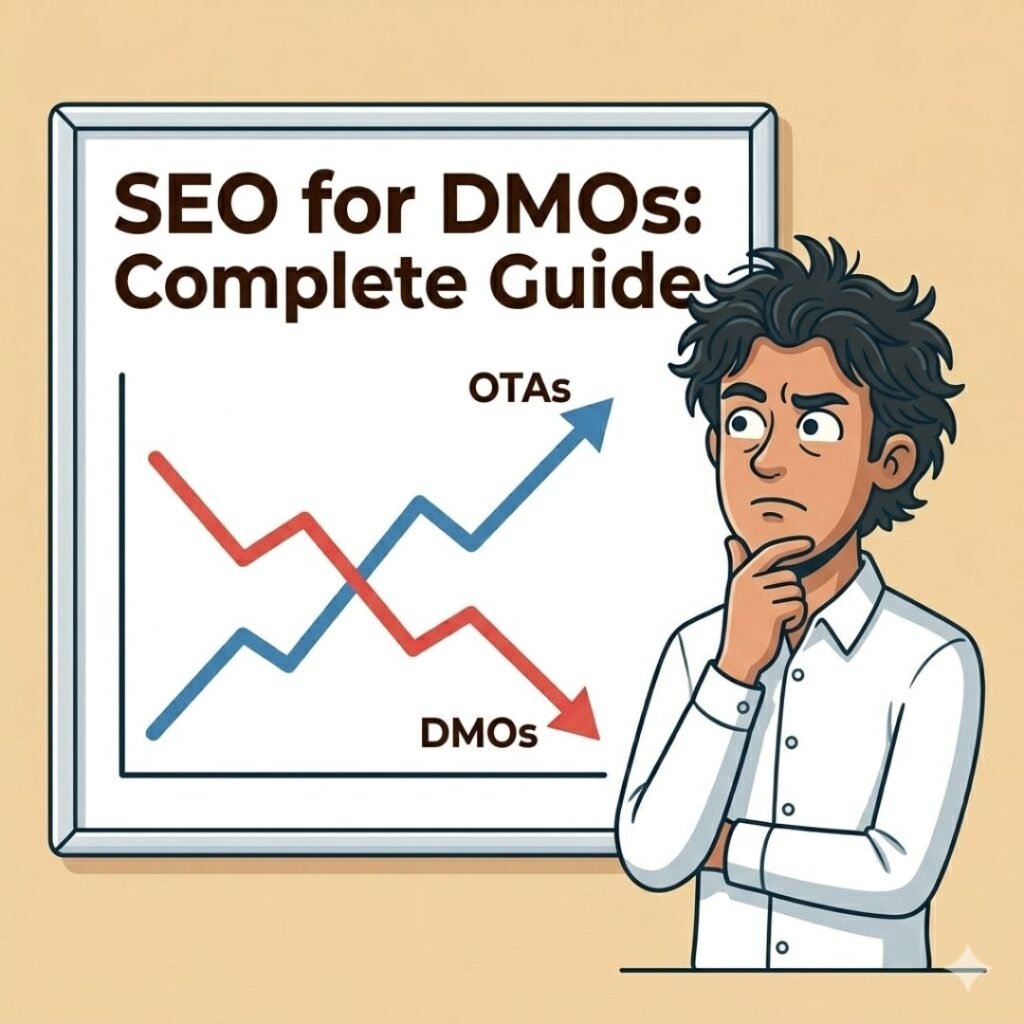
Every hotel owner I talk to has the same complaint: OTAs are eating their margins alive. Booking.com takes 15-25% commission. Expedia is not much better. And yet, when I audit their websites, I find the same problems over and over. Broken schema, thin content, zero local SEO strategy, and absolutely no plan for how AI search is reshaping hotel discovery.
I have spent the last decade working with hotels, DMOs, and tourism brands across three continents. From boutique dive resorts in Costa Rica to city hotels in Madrid, the principles are the same. Hotels that invest in SEO properly see 30-50% increases in direct bookings within 12-18 months. Those that treat their website as a brochure keep feeding the OTA machine.
This guide covers everything: technical foundations, content strategy, local SEO, and the emerging field of GEO/AEO that will determine which hotels show up in AI-generated travel recommendations. No fluff, no vague advice. Just what actually works.
Why Hotel SEO Matters More Than Ever
The economics are simple. A direct booking at a $200/night hotel saves you $30-50 compared to an OTA booking. Scale that across thousands of room nights and you are looking at hundreds of thousands in recovered revenue. I have seen properties add $150,000+ in annual profit just by shifting 10% of bookings from OTAs to direct.
But the search landscape has shifted. Google now shows hotel pack results, AI overviews, and rich features that push organic results down. Bing is integrated with ChatGPT. Travelers increasingly ask AI assistants for recommendations before they ever open a browser. If your hotel is not optimized for both traditional SEO and AI visibility, you are invisible to a growing segment of travelers.
When I worked with a 45-room boutique hotel in Guanacaste, they were getting 85% of bookings through OTAs. After 14 months of focused SEO work, we got that to 55%. That shift represented over $120,000 in commission savings annually. The SEO investment paid for itself in under three months.
Technical SEO Foundations for Hotels
Most hotel websites I audit fail at the basics. Here is what needs to be in place before anything else matters.
Site Speed and Core Web Vitals
Hotel websites are image-heavy by nature. Guests want to see the rooms, the pool, the views. But those high-resolution gallery images kill your page speed if handled poorly. I consistently see hotel sites with Largest Contentful Paint times over 6 seconds. Google wants under 2.5 seconds.
The fixes are straightforward but often ignored: implement WebP images with proper compression, lazy load anything below the fold, use a CDN, and make sure your booking engine does not block rendering. I use tools like Cloudflare, ImageKit, or built-in CMS optimization depending on the tech stack.
One property I worked with had a 4.2 second LCP that we got down to 1.8 seconds by implementing proper image handling and removing three unnecessary third-party scripts. Their bounce rate dropped 23% within six weeks.
Mobile Experience
Over 60% of travel searches happen on mobile devices. But hotel booking flows are notoriously bad on phones. Tiny date pickers, form fields that require zooming, booking widgets that break on certain screen sizes.
Test your entire booking flow on an actual phone, not just Chrome DevTools. I have found critical bugs that only appeared on Safari iOS or specific Android browsers. Your booking engine provider probably has mobile-responsive options you are not using.
Crawlability and Indexation
Hotel sites often have thousands of dynamically generated URLs from booking systems, date pickers, and filtered searches. If these are not properly handled with canonical tags, noindex directives, or parameter handling in Google Search Console, you end up with massive crawl waste and duplicate content issues.
Run a crawl with Screaming Frog or Sitebulb and look for: URLs with query parameters being indexed, multiple URLs for the same room type, pagination issues on photo galleries, and orphaned pages from old promotions. I typically find 500-2000 problematic URLs on a mid-sized hotel site.
Schema Markup for Hotels
This is where most hotels leave money on the table. Proper schema markup can get you enhanced search results showing ratings, price ranges, and amenities directly in Google. It also feeds AI systems the structured data they need to recommend your property.
At minimum, implement: Hotel schema on your homepage, LodgingBusiness schema with correct aggregate ratings, Room schema for each room type with offers and pricing, LocalBusiness schema with accurate NAP and hours, and FAQPage schema for any Q&A content.
Use Google’s Rich Results Test to validate everything. I see hotels with schema that throws errors because their developer copy-pasted something without understanding it. Broken schema is worse than no schema because it confuses search engines.

Content Strategy That Drives Bookings
Hotel content strategy is not about blogging randomly. It is about building a content ecosystem that captures travelers at every stage of their journey and guides them toward booking directly.
Room and Suite Pages
Your room pages are your money pages. They need to rank for searches like “oceanfront suite [destination]” and “family room hotel [city]”. Yet most hotel room pages are thin content disasters with 50 words and a bullet list.
Each room type needs: 300-500 words of unique descriptive content, a full amenity list with actual details (not just “TV” but “55-inch smart TV with Netflix”), high-quality images with descriptive alt text, embedded booking functionality, and FAQ content addressing common questions about that room type.
I restructured room pages for a mountain resort in Colorado and saw individual room pages start ranking for long-tail queries they had never appeared for. The premium suite page alone drove an additional $40,000 in direct bookings over 8 months.
Destination Content
Travelers do not just search for hotels. They search for information about their destination. “Things to do in [city]”, “best restaurants near [landmark]”, “weather in [destination] in [month]”. If your hotel is not answering these queries, you are missing the top of the funnel entirely.
Create comprehensive destination guides that position your hotel as the local expert. Cover neighborhood guides for your immediate area, seasonal activity content, day trip itineraries, local dining recommendations, and transportation guides. Link naturally to your booking pages from this content.
When I built destination content for CostaRicaDivers.com, we created guides for every dive site, every beach, every season. That content hub drove 40% of our organic traffic and established us as the authority in the region. Hotels can do the same.
Event and Seasonal Content
Map out every major event, festival, and seasonal attraction near your property. Create dedicated landing pages targeting queries like “hotel near [festival]” or “where to stay for [event]”. Update these annually with fresh dates and details.
This content has strong commercial intent and often less competition than generic destination queries. A 35-room hotel I worked with in Seville created pages for Semana Santa, Feria de Abril, and three other major events. Those five pages now generate 15% of their direct bookings.
Wedding and Group Travel Content
If your property hosts weddings, corporate retreats, or group events, you need substantial content targeting these segments. These are high-value bookings that often go to whoever shows up first with convincing information.
Create dedicated landing pages with: detailed venue information and capacities, photo galleries specific to events, case studies or testimonials from past events, clear contact forms and RFP processes, and FAQ sections addressing common planning questions.
Local SEO for Hotels
Your Google Business Profile is probably your most important digital asset after your website. When travelers search “hotels near me” or “hotels in [city]”, the local pack results dominate the page. If you are not showing up there, you are invisible.
Google Business Profile Optimization
Claim and verify your profile if you have not already. Then optimize every field: select all relevant categories (Hotel is primary, but add Restaurant, Event Venue, etc. if applicable), add all services and amenities using Google’s predefined attributes, upload at least 25 high-quality photos across all categories, write a compelling business description using your target keywords naturally, and add all room types as products with descriptions and pricing.
Keep your profile active. Post weekly updates about events, seasonal offerings, or local happenings. Respond to every review within 48 hours. Google rewards engagement.
Review Strategy
Reviews are a ranking factor for local search and a conversion factor for bookings. You need a systematic approach to generating reviews, not just hoping guests will leave them.
Send a review request email 2-3 days after checkout when the experience is fresh. Make the link dead simple with a direct Google review URL. Train front desk staff to mention reviews during positive interactions. Some properties use QR codes at checkout.
Respond to negative reviews professionally and with specific solutions. I have seen hotels turn negative reviewers into repeat customers with genuinely helpful responses. And potential guests notice when management actually cares.
Citation Building and Consistency
Your NAP (name, address, phone) needs to be exactly consistent across every directory, listing, and website that mentions your hotel. Inconsistencies confuse search engines and erode trust.
Beyond the obvious (Google, Bing, Apple Maps, Yelp), ensure consistency on: TripAdvisor, OTA profiles (even if you hate them, they are citations), local tourism board directories, chamber of commerce listings, and wedding and event directories if relevant.
Use a tool like BrightLocal or Whitespark to audit your citations and identify inconsistencies.
GEO and AEO: AI Search Optimization for Hotels
This is the frontier. ChatGPT, Google’s AI Overviews, Bing Chat, and Perplexity are changing how travelers discover hotels. When someone asks “recommend a boutique hotel in Madrid with rooftop bar”, which properties get mentioned?
I have been tracking AI search behavior for over a year now, and the patterns are becoming clear. AI systems synthesize information from multiple sources. They favor properties with strong brand signals, comprehensive structured data, and presence across authoritative travel content.
Structured Data for AI Visibility
AI systems rely heavily on structured data to understand entities. Your schema markup is not just for Google anymore. It is how you communicate facts about your property to any AI that crawls your site.
Ensure your schema includes: complete amenity lists, accurate star ratings and review aggregations, detailed room information with pricing, location coordinates and neighborhood context, and relationships to nearby attractions.
Brand Mentions and Digital PR
AI systems build entity understanding from mentions across the web. If your hotel is mentioned in travel publications, local news, tourism board content, and influential blogs, AI systems recognize you as a relevant entity for specific queries.
Invest in digital PR: pitch stories to travel journalists, contribute expert quotes to destination articles, get featured in “best of” lists, and build relationships with local tourism content creators. These mentions compound over time into AI visibility.
Answer-Focused Content
AI systems are trained on Q&A content. When you structure your website content to directly answer common questions, you increase the likelihood of being cited in AI responses.
Build FAQ content around: “Is [hotel] good for families?” “Does [hotel] have airport shuttle?” “What is the best room type at [hotel]?” Answer these directly on your site with schema markup.
Link Building for Hotels
Hotels have natural link building opportunities that most industries envy. You just need to leverage them.
Local Partnerships
Every business you partner with is a link opportunity: local tour operators, restaurants with referral relationships, wedding vendors, corporate travel agencies, and event venues. Ensure these partnerships include links to your website.
Tourism Board and DMO Links
Most destination marketing organizations have accommodation directories. Get listed and ensure your link is accurate. These are highly authoritative local links.
Content-Driven Links
Your destination content should naturally attract links if it is genuinely useful. Create resources that local businesses want to reference: neighborhood guides, event calendars, transportation information, and local tips that fill information gaps.
Measuring Hotel SEO Success
Track metrics that matter to the business, not vanity metrics.
- Primary KPIs: direct booking revenue from organic search, organic traffic to booking pages, conversion rate from organic visitors, and direct booking share vs OTA share.
- Secondary metrics: rankings for priority keywords, local pack visibility, page speed scores, and review volume and sentiment.
Set up proper analytics segmentation to isolate organic traffic and track through the booking funnel. Most hotels I audit have broken analytics that cannot actually tell them where bookings come from.
Common Hotel SEO Mistakes I See Constantly
After auditing 50+ hotel websites, these problems appear in almost every one. Over-reliance on OTA-style booking widgets that create duplicate content. Thin room pages with no unique content, no destination content strategy whatsoever. Broken or missing schema markup, ignored Google Business Profile with stale information. No mobile optimization of the booking flow, and zero awareness of AI search optimization.
Fix these fundamentals before chasing advanced tactics. The basics still drive the majority of results.
Frequently Asked Questions
How long does hotel SEO take to show results?
Expect 4-6 months for initial ranking improvements and 12-18 months for significant direct booking increases. Technical fixes can show impact within weeks. Content and link building take longer. I tell clients to plan for at least a 12-month commitment before judging ROI.
Should hotels still list on OTAs if they are doing SEO?
Yes, but strategically. OTAs provide exposure and help fill inventory. The goal is shifting the ratio, not eliminating OTAs entirely. I typically target moving from 80% OTA / 20% direct to 50/50 or better. OTA presence also creates citations and brand signals that indirectly help SEO.
How important is blogging for hotel SEO?
Random blogging is worthless. Strategic destination content is valuable. Do not write “5 reasons to visit our hotel” that no one searches for. Write comprehensive guides to local attractions, events, and experiences that travelers actually search for. Tie that content to your booking pages with clear paths.
Can small independent hotels compete with big chains in SEO?
Absolutely, and often more effectively for local queries. Big chains have domain authority but often thin, template content for individual properties. An independent hotel with genuinely useful local content, strong reviews, and proper optimization can dominate local pack results and long-tail queries. I have seen 30-room properties outrank major chains for their target destination queries.
What is the biggest SEO opportunity most hotels miss?
Destination content without question. Most hotels treat their website as a booking widget instead of a destination resource. Travelers research extensively before booking. If your hotel is the one answering their questions about the area, you build trust that converts. The hotel that becomes a trusted local resource wins the booking.
How does AI search change hotel SEO strategy?
AI systems synthesize information differently than traditional search. They favor entities with strong brand signals, comprehensive structured data, and consistent information across authoritative sources. Hotels need to think beyond just ranking in Google to being recommended by AI assistants. This means investing in structured data, digital PR, and answer-focused content that AI can easily understand and cite.
Get a Hotel SEO Audit
If you are tired of watching OTA commissions eat your margins and want to understand exactly what is holding your hotel back from direct bookings, let’s talk. I offer comprehensive SEO audits specifically for hotels that identify technical issues, content gaps, and missed opportunities across traditional and AI search.

Written by Peter Sawicki, an experienced strategist with a background spanning multiple industries, from private enterprises to government projects. Having worked across different countries and markets, I bring a global perspective and practical insights to every SEO strategy I design. As a diver and adventure seeker, I’ve learned to balance attention to detail with a drive to explore new solutions, a mix that shapes both my work and my life.