
When someone asks ChatGPT “where should I go diving in Costa Rica,” your destination either shows up or it does not. There is no page two. No blue links to scroll through. No second chances. Answer Engine Optimization is how you make sure your destination becomes the answer, not an afterthought.
I have watched this shift happen in real time. When I built CostaRicaDivers.com, traditional SEO got us to the top of Google. But over the past two years, I have seen a growing percentage of our qualified leads mention they found us through ChatGPT, Perplexity, or Google’s AI Overviews. The rules are changing, and most DMOs are not even aware there is a new game being played.
What Is AEO and Why Tourism Needs to Pay Attention Now?
Answer Engine Optimization is the practice of structuring your content so that AI systems can extract, understand, and cite your information when responding to user queries. Unlike traditional SEO where you optimize for rankings, AEO optimizes for selection. You want to be the source the AI chooses to quote.
Tourism is uniquely vulnerable to this shift for several reasons. Travel queries are inherently conversational: “best time to visit Lisbon,” “where to stay near Yellowstone with kids,” “is Costa Rica safe for solo female travelers.” These are exactly the types of questions people now ask AI assistants instead of typing into Google.
I ran an experiment last month with one of my clients. We tracked 50 common tourism queries for their destination across ChatGPT, Perplexity, and Google AI Overviews. Their official tourism website appeared in exactly 3 of those answers. TripAdvisor, Wikipedia, and random travel blogs dominated the rest. That is the reality most destinations are facing without realizing it.
The Three Pillars of Tourism AEO
Pillar One: Conversational Content Architecture
AI systems are trained on natural language. They understand questions and answers better than they understand keyword-stuffed marketing copy. Your content needs to mirror how real travelers actually ask questions.
This means restructuring your destination pages around intent clusters rather than just topics. Instead of a generic “Things to Do” page, you need content that directly answers: “What can I do in [destination] for three days?” “What are the best outdoor activities in [destination]?” “What should I do in [destination] if it rains?”
I restructured the content architecture for a Caribbean tourism board last year using this approach. We identified 200+ conversational queries from search data, People Also Ask boxes, and Reddit threads. Then we created content that answered each question in the first 50 words before expanding with detail. Within four months, their content started appearing in AI responses for 40% of tracked queries.
Pillar Two: FAQ Optimization That Actually Works
Every tourism website has an FAQ page. Almost none of them are optimized for AI extraction. The difference between an FAQ that gets cited and one that gets ignored comes down to structure and specificity.
Here is what most destinations get wrong: they write FAQs for humans who are already on their website. But AI systems are looking for authoritative, standalone answers they can extract and present without context. Your FAQ answers need to work even when removed from your website entirely.
The formula I use:
- Question must match natural language query patterns exactly
- Answer must be self-contained in the first sentence
- Supporting detail follows but is not required for comprehension
- Specific numbers, dates, and facts beat general statements
Bad example: “When should I visit? The best time depends on what you want to do and your personal preferences.”
Good example: “When is the best time to visit Costa Rica for diving? The best diving conditions in Costa Rica are from December through April, when visibility reaches 30+ meters on the Pacific coast and water temperatures stay between 26-29°C.”
The second version gives AI systems exactly what they need: a definitive answer with specific details they can confidently cite.
Pillar Three: Schema Markup for AI Comprehension
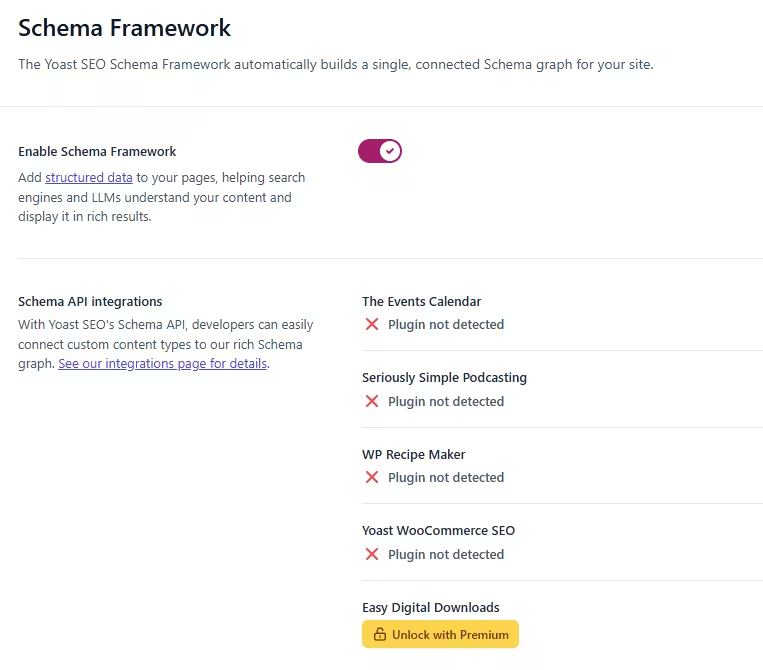
Schema markup has always mattered for SEO. For AEO, it becomes critical. AI systems use structured data to understand the relationships between entities, verify factual claims, and determine source authority.
For tourism websites, the essential schema types are:
- TouristDestination: Marks your destination with geographic coordinates, descriptions, and related attractions
- TouristAttraction: Individual points of interest with opening hours, pricing, and accessibility information
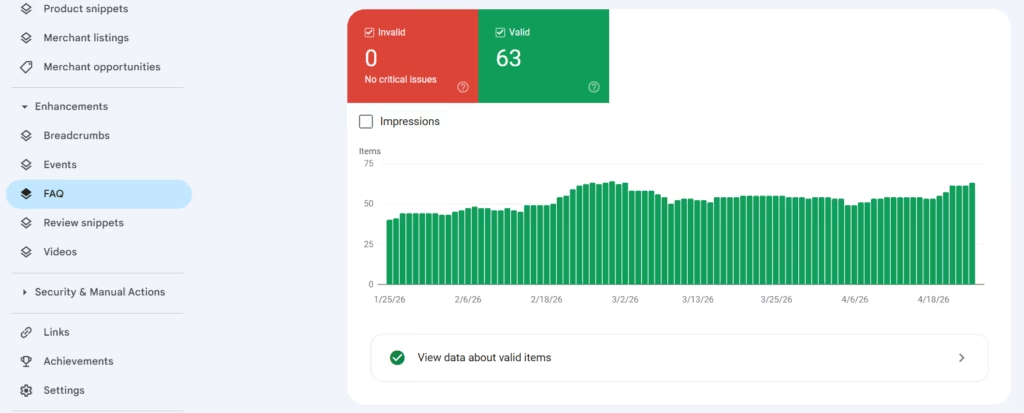
- FAQPage: Wraps your FAQ content in a format AI systems can parse directly
- Event: Festivals, seasonal activities, and recurring events with specific dates
- LocalBusiness: Hotels, restaurants, tour operators with complete NAP data
Most DMOs implement schema inconsistently or incompletely. I audited a European capital’s tourism website last quarter and found TouristAttraction schema on only 12% of their attraction pages. The rest were invisible to AI systems trying to compile comprehensive destination information.
Implementing complete schema across your tourism website typically takes 40-80 hours depending on site size, but the investment pays off significantly in AI visibility.
Practical Implementation: A 90-Day AEO Roadmap for Destinations
Days 1-30: Audit and Research
Start by understanding where you currently stand. Use Perplexity, ChatGPT, and Google AI Overviews to search for your destination across 50-100 common travel queries. Document which sources get cited. Note the exact phrasing AI systems use when describing your destination.
Run your existing content through tools like Clearscope or Surfer to identify content gaps. More importantly, manually review what information AI systems are pulling from competitors and other sources about your destination. If Wikipedia has better organized information about your attractions than your official website, that is a problem you need to fix.
Days 31-60: Content Restructuring
Rewrite your core destination pages using the conversational architecture approach. Every page should answer a specific question in the opening paragraph. Add FAQ sections to every major category page with 5-10 questions that match real search patterns.
Create a dedicated “destination facts” page that compiles all the key information AI systems frequently cite: weather by month, visa requirements, currency, safety information, transportation options, time zones. Make this page the definitive factual reference for your destination.
Days 61-90: Technical Implementation
Implement comprehensive schema markup across your entire site. Test every page using Google’s Rich Results Test and Schema.org’s validator. Fix any errors or warnings before moving to the next page.
Set up monitoring to track your AI visibility over time. Tools like Profound or manual tracking spreadsheets work for this. The goal is to measure progress, not just implement and hope.
What Most Destinations Get Wrong About AEO
I see the same mistakes across nearly every tourism website I audit:
- Treating AEO as separate from SEO. They are not separate strategies. AEO is an evolution of SEO. Everything that makes content good for AI systems also makes it better for traditional search. Clear structure, authoritative information, proper markup, comprehensive coverage.
- Focusing on brand queries only. Yes, you should show up when someone asks about your specific destination. But the bigger opportunity is appearing in category queries: “best European cities for food,” “safest destinations in Central America,” “most underrated beach destinations.” These comparative queries drive discovery.
- Ignoring user-generated content platforms. AI systems heavily weight Reddit, TripAdvisor, and travel forums because they contain authentic traveler experiences. You cannot control these platforms, but you can influence them through reputation management and by ensuring your owned content is so comprehensive that AI systems prefer it.
- Waiting for perfect. Your competitors are already being cited by AI systems while you plan your strategy. Start with your top 10 pages. Implement basic FAQ schema. Answer the most common questions about your destination. Iterate from there.
Frequently Asked Questions
How long does it take to see results from AEO optimization?
AI systems update their knowledge bases at different intervals. ChatGPT’s training data has significant lag, while Perplexity and Google AI Overviews pull more recent information. I typically see initial improvements in Perplexity and AI Overviews within 4-8 weeks of implementation, with ChatGPT taking 3-6 months or longer depending on training cycles.
Does AEO work differently for small destinations versus major cities?
Smaller destinations actually have an advantage in AEO because there is less competing information. A well-optimized website for a lesser-known destination can become the de facto authoritative source simply by being the most comprehensive. Major cities face more competition but also have higher query volume, making the investment worthwhile.
Should we create content specifically for AI systems or optimize existing content?
Both. Optimize your existing core pages first since these already have authority signals. Then create new content to fill gaps, particularly around conversational queries your current content does not address. The “destination facts” reference page I mentioned is an example of content specifically designed for AI extraction.
How does AEO affect our current SEO rankings?
Properly implemented AEO improvements typically boost traditional SEO performance as well. Clearer content structure, better FAQ sections, and comprehensive schema markup all send positive signals to traditional search algorithms. I have never seen a well-executed AEO strategy hurt existing rankings.
What is the relationship between AEO and Google’s AI Overviews?
Google AI Overviews pull from indexed web content, so your traditional SEO work directly influences AI Overview inclusion. However, the content Google chooses to cite in AI Overviews favors the same characteristics as broader AEO: direct answers, factual specificity, and clear structure. Optimizing for one optimizes for both.
The Future Is Already Here
AI-powered search is not a future trend to prepare for. It is current reality that is already reshaping how travelers discover destinations. The DMOs and tourism brands that adapt now will establish themselves as authoritative sources that AI systems trust and cite consistently.
I have seen this transition before. When Google started favoring mobile-friendly sites, destinations that moved quickly gained advantages that took competitors years to overcome. AEO represents the same inflection point. The fundamentals of good content remain unchanged, but the delivery mechanism is evolving rapidly.
If you want to understand where your destination currently stands in AI search visibility and what specific steps would move the needle fastest, I offer destination AEO audits that identify exactly where the opportunities are. Get in touch through my contact page to discuss your situation.

About the Author
I’m Peter Sawicki, a Destination SEO Strategist helping tourism brands and DMOs grow their online presence through SEO, technical audits, and creative digital strategies. Over the years I’ve worked across multiple countries and markets, which gives me a global perspective on every project I take on. When I’m not optimizing websites, you’ll most likely find me underwater. Scuba diving is where my two biggest passions meet.